
By William Daughtry
ATHENS, Ga. — May 5, 2023
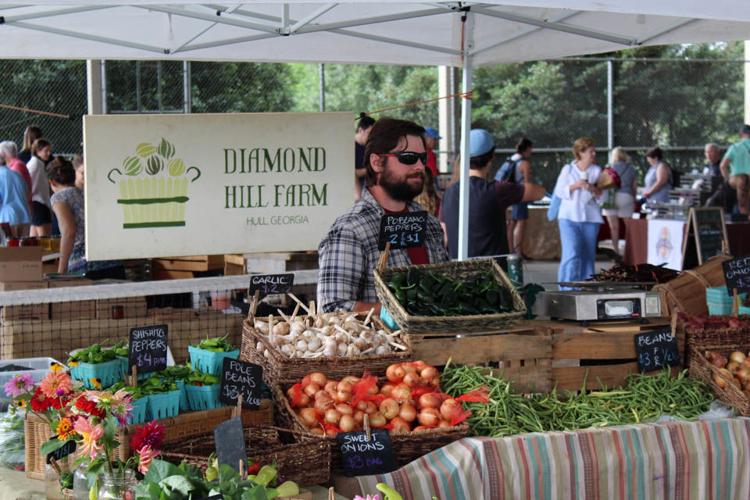
Diamond Hill Farm, a vendor at the Athens Farmers Market, set up in Athens, Georgia on Aug. 18, 2018. Photo via Caitlin Jett, Red and Black.
Customers file into the Athens Farmers Market one by one. The sun beats down on a spring day in Athens, as shoppers are faced with a multitude of options to choose from. On display for one of the vendors are radishes, lettuce, flowers and fruit. Customers hand-pick their produce and have the option to pay with Supplemental Nutrition Assistance Program (SNAP) benefits, which counts as double at the market.
This is one of the many ways people in the Athens-Clarke County community are leading the charge on sustainability.
Between electrifying the transit fleet, complete renewable energy within the government by 2035 and efforts led by the University of Georgia, sustainability has been on the rise in Athens.
“It’s so inspiring to hear the work that people are doing and the reasons why they’re doing the work,” Aron Hall, the energy program and conservation coordinator for Athens-Clarke County said.
According to Hall, many sustainability offices—especially in the southeast—are just starting. This is compounded with the fact that most offices are understaffed. The sustainability office in Athens-Clarke County lists just three members on their website.
CLIMATE CHANGE PUSHES SUSTAINABILITY TO THE FOREFRONT
The push for sustainability has come at the heels of climate change. According to the National Oceanic and Atmospheric Administration (NOAA), global temperatures have risen by 1.98 F over the last century. The average thickness of 30 “well-studied” glaciers have decreased by more than 60 feet in thickness since 1980. It is a complex issue that requires complex solutions.
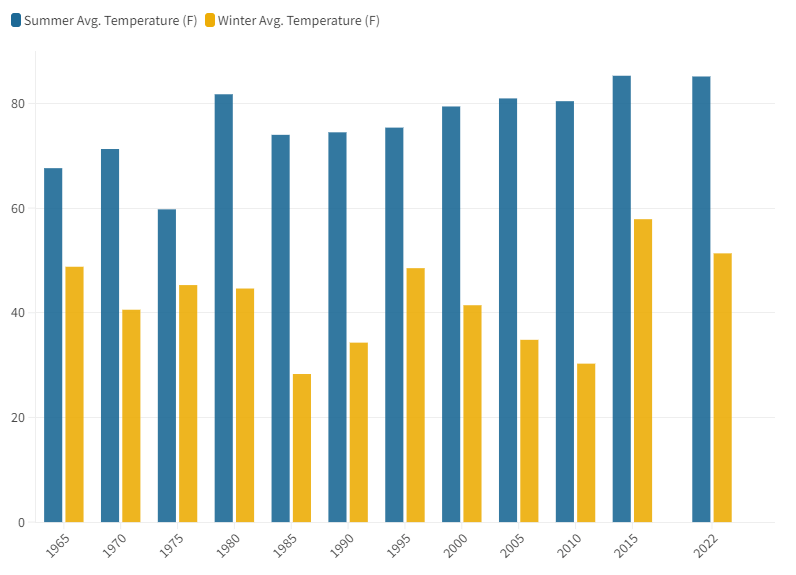
This chart indicates the summer and winter month temperature change in North Georgia over time. The data was derived from NOAA and is taken from an average temperature of June and of December since 1965 in Atlanta. Graph was made by William Daughtry.
One of the key solutions is sustainability. In 2015, the United Nations implemented a 17-point plan known as the sustainable development goals that aim to “serve as a shared blueprint for peace and prosperity for people and the planet, now and into the future.”
What we have seen in Athens for sustainability follows a trend seen on a national level. In a 2023 poll by Pew Research Center, it was shown that 69% of Americans favor the United States taking steps to become carbon neutral by 2050.
LOCAL-LEVEL SOLUTIONS
The goal of mitigating impacts has proliferated at the government level. Athens Mayor Kelly Girtz has a goal set in place for all Athens-Clarke County government buildings to be fully sustained by renewable energy by 2035 and for the entire community by 2050. On a national level, clean energy consumption has been on the rise, with the percentage from renewable sources almost doubling since 2000 according to a 2019 report by the sustainable development goal tracker.
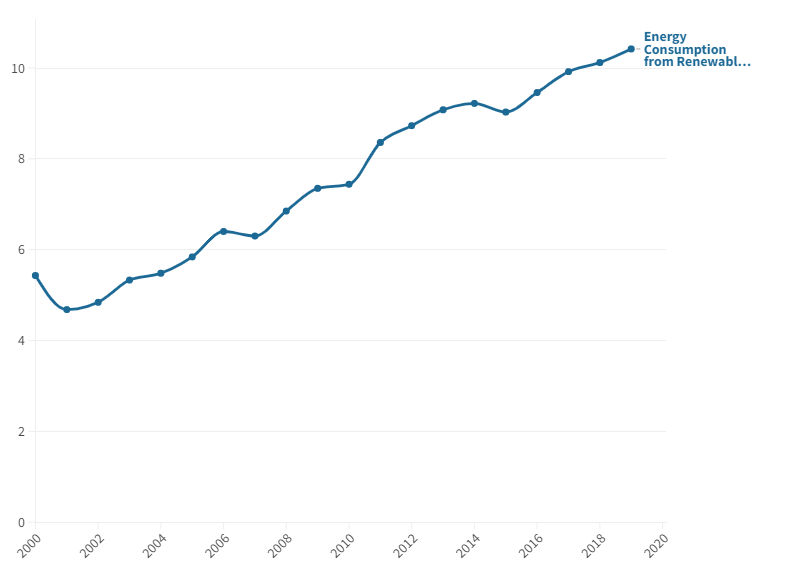
The chart indicates energy consumption from renewable sources over time, as a percentage. The chart shows an increase in renewable sources, with only three drops year-to-year since 2000. Data from the Sustainable Development Goal tracker by the United Nations. Graph created by William Daughtry.
“There’s sort of a common framework of environmental sustainability,” Girtz said. “Part of what’s inherent in that word is that you’re talking about something that’s of high quality and health benefit to human beings that will last a long time.”
Along with Girtz’s plan after his election win in 2018 for 100% renewable energy in the Athens community is a transit development plan that Girtz hopes will “enhance connectivity.”
This plan would make it to where every Athenian can travel around the county safely and electrify the bus fleet, with the government adding 12 electric buses to the transit system in 2018.
THE UNIVERSITY OF GEORGIA STEPS IN TO HELP, GARNERS SUPPORT
The University of Georgia has also stepped in, creating the office of sustainability in 2010. Tyra Byers, who has been with the university since 2008, works in the office as the director of interdisciplinary sustainability certificate.
“There was a lot of momentum around sustainability,” Byers said. “Our president at the time, President Adams established a task force looking at sustainability at UGA and then there was a ton of student momentum.”
Byers got her education at the Cal-Berkeley and her master’s from the University of California at Santa Barbara, noting key differences between the two states.
“There’s a lot more top-down directives in terms of sustainability in California,” Byers said. “A lot of initiatives in Georgia start more grassroots and bubble up.”
Byers even referenced key differences in the clean-up cultures on game days.
“My son goes to the University of Southern California and when I go to a football game, during tailgating they have just as much cardboard, but they have those cardboard bins of compost, recycling and trash and everything is going in the appropriate bin, and nothing is on the ground,” Byers said.
The University of Georgia has seen sustainable plans on campus by way of fully electric buses on campus purchased in 2019 and the Bulldog Bike Share program started in 2022.
According to the University of Georgia’s transportation and parking services, the energy costs for the new buses are approximately $10 a day as opposed to the diesel buses costing roughly $100 a day.
“I think the students at UGA are incredibly passionate,” Byers said. “It [the office of sustainability] required incredible student passion, initiative and drive and activism to make it happen.”
COMMUNITY LEVEL EFFORTS AT THE ATHENS FARMERS MARKET
In the community, the Athens Farmers Market hosts an array of vendors that allows for community sustainability. To promote this, there are three requirements that all vendors must abide by: Farmers must grow everything they sell, they must practice under USDA-certified organic rules and their farm must be within the 25-county region that surrounds Athens-Clarke County.
One of these vendors, Diamond Hill Farm, practices community supported agriculture (CSA) shares.
Community supported agriculture has begun to flourish—Diamond Hill Farm began the practice in March—as it involves consumers paying a fixed price monthly or weekly and getting a predesignated share of the produce. This is mutually beneficial to the farmer and the consumer, as it allows a consumer to support a local farmer, get organic food inexpensively and reduces the cost for both the consumer and farmer alike.
“It’s a very communal thing,” Claire Johnson, the community supported agriculture manager for Diamond Hill Farm, said. “We get regulars who come by, and we start to know each other by our first names.”
This community sense with CSAs have been well-documented as it allows the consumer member to invest in a farm (the money generally goes to equipment, seeds, etc.) while taking the “guesswork out of eating seasonally” according to Diamond Hill’s website, allowing the member to be more “in tune” with what grows on a farm.
MAYOR KELLY GIRTZ ON IMPROVEMENT IN SUSTAINABILITY
With efforts like the farmers market, transportation and renewable energy, sustainability in Athens has come a long way according to Girtz.
“There are threads of this that came from the administrations of other mayors, and I sort of carried the torch forward,” Girtz said. “But I think what we’ve been able to do is add to them and add these clean energy pieces.”
Adding to the sustainability measures already in place has been a huge factor in Girtz’s platform, but his proudest measure has been the enhanced connectivity in public transit.
“The ability of people no matter what neighborhood you live in to get around safely, to be able to walk and bike and be with your friends and neighbors and get to work is the stuff I’ll carry with me forever,” Girtz said.

